Proton therapy can spare healthy tissue far better than conventional radiotherapy, but planning a treatment requires computing how dose is deposited in 3D for thousands of individual beamlets. Gold-standard Monte Carlo simulation is accurate but slow, which limits adaptive, on-the-day replanning.
Fast deep-learning dose engines exist, but they must reinterpolate the 3D CT grid to align with each beamlet's direction — a costly step repeated for every beamlet in a plan.
Calculate Monte-Carlo-accurate 3D proton dose distributions fast enough to support adaptive treatment planning.
Medical physicists, radiation oncologists, and ultimately patients undergoing proton therapy.
I designed, implemented, trained and validated the model end-to-end, and authored the resulting publication.
Instead of rotating the grid, ADoTA informs the model of beam orientation through an analytical projection of the beamlet shape along its central axis. Reinterpolation is then required only once per field rather than once per beamlet.
A transformer-based dose engine (building on the DoTA line of work) that takes a 3D CT patch, the projected beamlet shape and the mean beamlet energy, and predicts the deposited 3D dose distribution.
Beamlet-level gamma pass rates above 98–99% across anatomies — including sites not seen during training — with dose calculation dramatically faster than Monte Carlo.
Preprint on arXiv (2026); ongoing work on robust and adaptive planning.
Technical deep dive Implementation detail
Acknowledgments
This work was made possible thanks to the immense support of my supervisors and the Biomedical Intervention Optimisation Lab at TU Delft.
Aim of the project
We developed a deep-learning-based dose engine that accurately predicts a 3D dose distribution deposited by a proton beamlet. The proposed model — Angle Dependent Dose Transformer Algorithm (ADoTA) — motivated by the work performed by Pastor-Serrano and Perko, predicts a 3D dose distribution based on a provided 3D grid representing a CT image, the projection of the proton beamlet shape along its central axis, and the mean proton beamlet energy.
Contribution and novelty
In contrast to the original DoTA algorithm, we propose a solution that is agnostic to beamlet angles. The model is informed about the beamlet angles through the projection of the proton beamlet shape along its central axis. With this approach, reinterpolation of the grid is required only at the field level, which significantly accelerates the generation of the full treatment plan.
Evaluation methodology
To validate the correctness of the developed model, we quantify the difference between calculated dose distribution ($ \hat{\mathbf{y}} $) by our model with Ground Truth ($ \mathbf{y} $) generated with use of the MCsquare Monte Carlo dose engine. To express the differences we use two metrics:
- Gamma Pass Rate
- Relative Dose Error $ \rho $
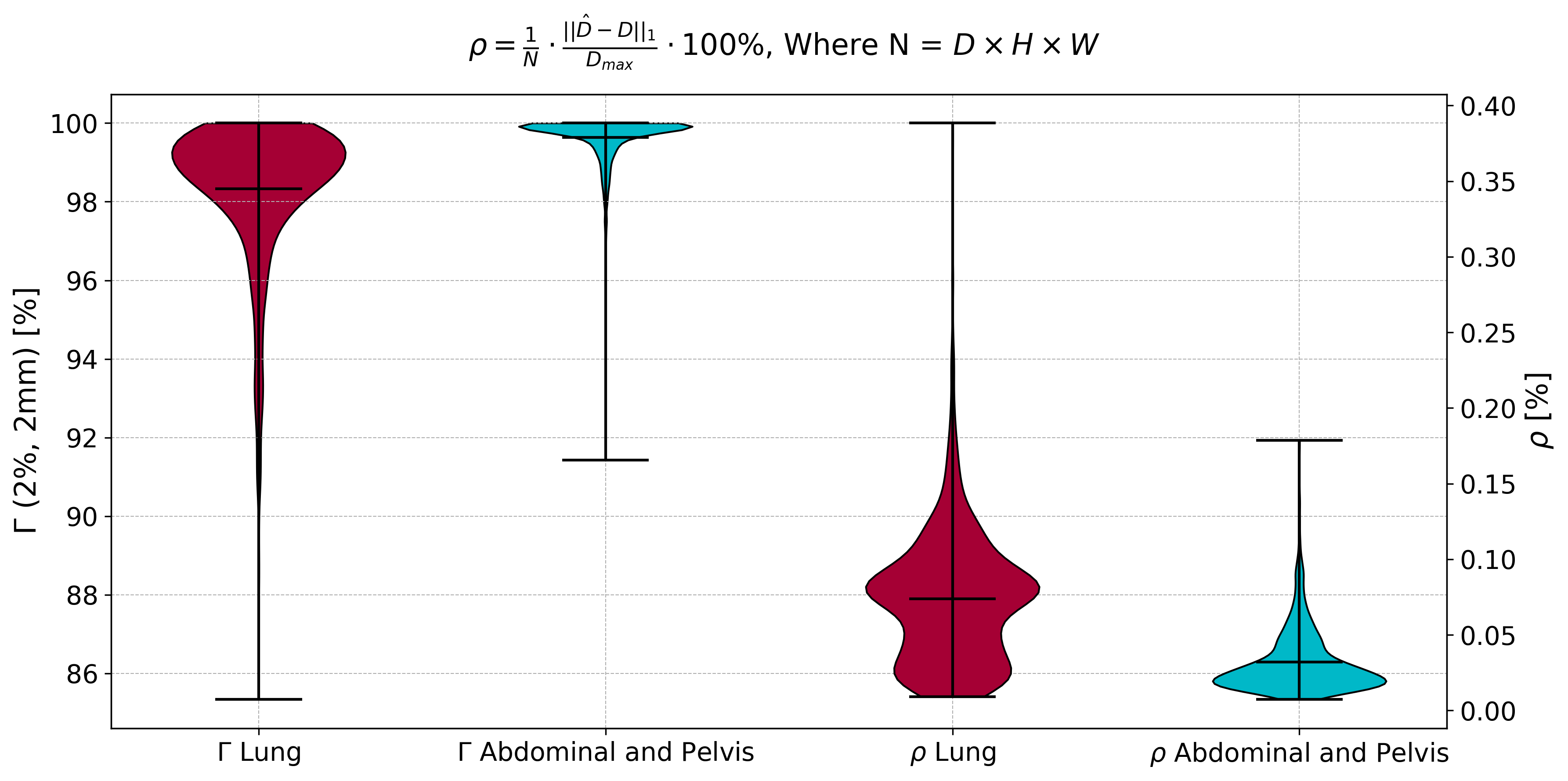
Relative Dose Error ($ \rho $) is used to straightforward two 3D dose distributions comparison. Given the $ \hat{\mathbf{y}} $ and $ \mathbf{y} $ with number of voxels $ n_v = D \times H \times W $, where $ D $, $ H $ and $ W $ stand for depth, height and width of the dose grid respectively, the average relative dose error $ \rho $ can be calculated as
\[\rho = \frac{1}{n_v} \frac{||\mathbf{y} - \hat{\mathbf{y}}||_{L1}}{max(\mathbf{y})} \times 100 [\%]\]Gamma Pass Rate ($ \Gamma $) is a standard metric used in radiotherapy to estimate the similarity between calculated and measured dose distributions. Given $ r(\mathbf{r}_c, \mathbf{r}_r) = \text{abs}(\mathbf{r}_c - \mathbf{r}_r) $ and $ \sigma(\mathbf{r}_c, \mathbf{r}_r) = D_c(\mathbf{r}_c) - D_r(\mathbf{r}_r) $, Gamma Pass Rate is defined as:
\[\Gamma(\mathbf{r}_c, \mathbf{r}_r) = \sqrt{(\frac{\sigma^2(\mathbf{r}_c, \mathbf{r}_r)}{\Delta D^2} + \frac{r^2(\mathbf{r}_c, \mathbf{r}_r)}{\delta d^2})}\]Where $ \Delta D $ and $ \delta d $ stand for the dose difference criterion and distance-to-agreement (DTA) criterion. To calculate $ \Gamma $ we use the method from the pymedphys package. To express similarity as a single number, we use the gamma index $ \gamma(\mathbf{r}_r) $ defined as
\[\gamma(\mathbf{r}_r) = \text{min} \{ \Gamma(\mathbf{r}_c, \mathbf{r}_r) \} \forall \{ \mathbf{r}_c \}\]The $ \gamma(\mathbf{r}_r) \leq 1 $ states that the predicted dose met the criteria at a specific voxel. For analysed 3D dose distributions, we quantify the ratio of passing voxels to all accessible voxels.
Results
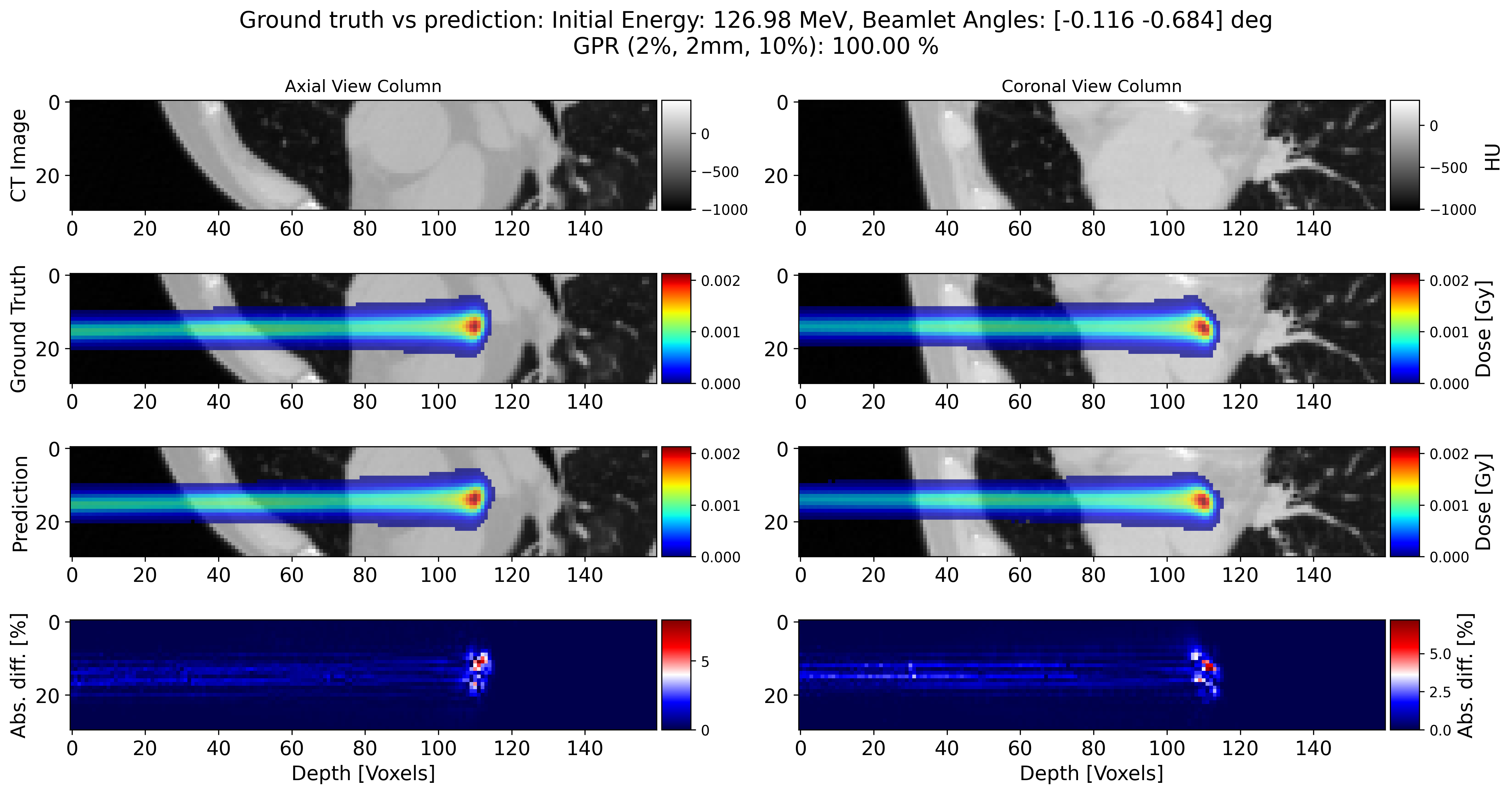
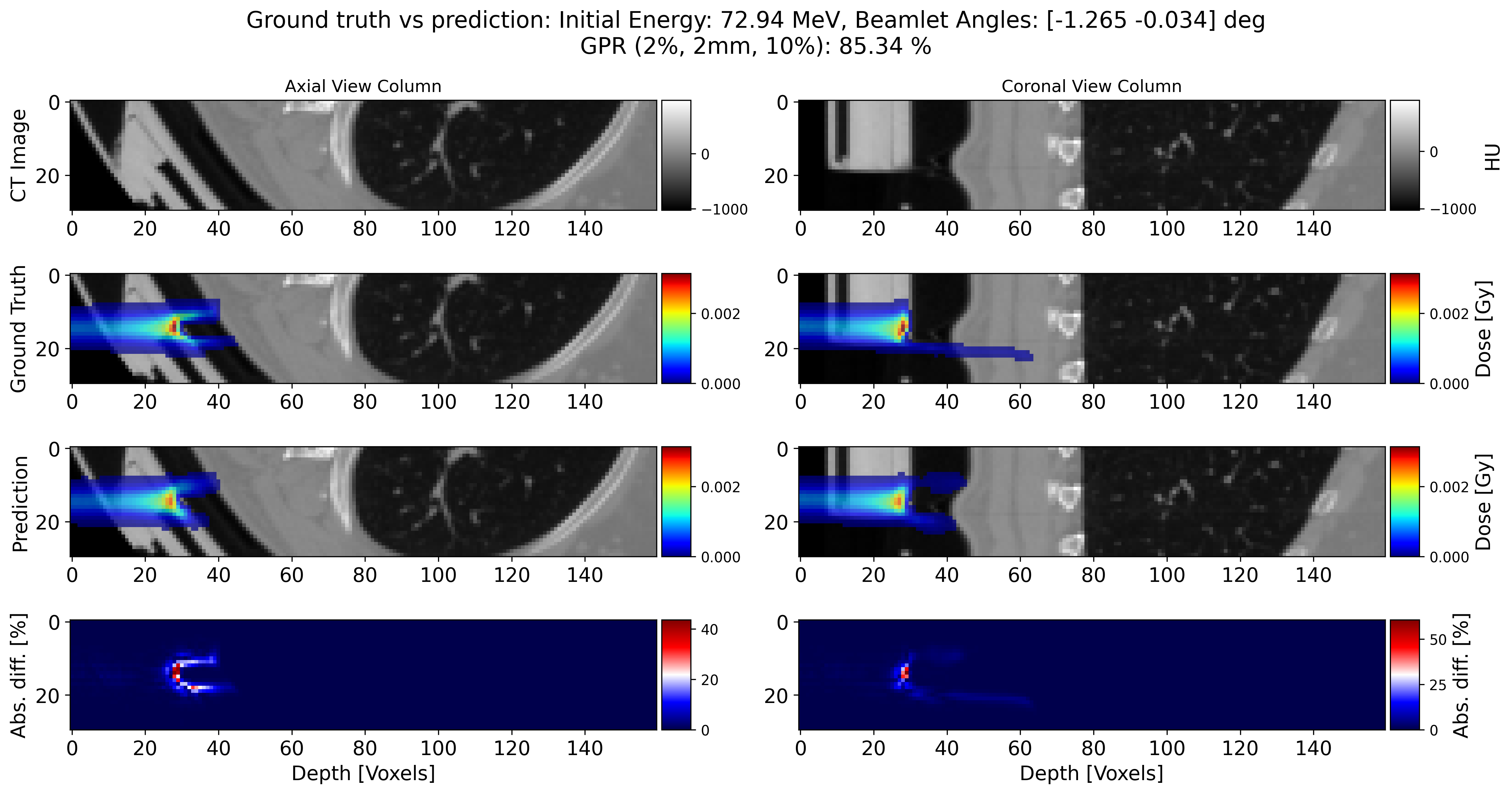
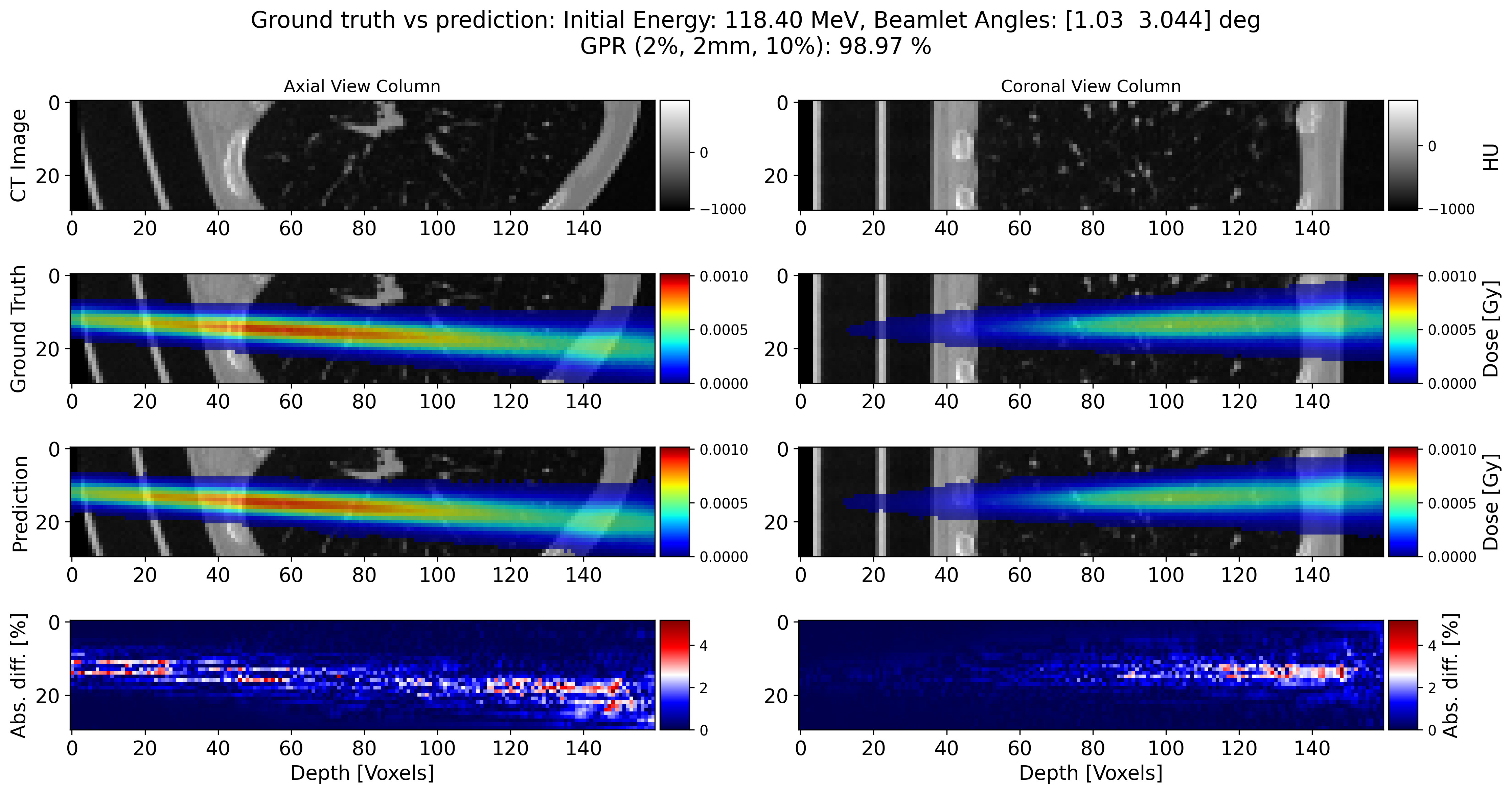
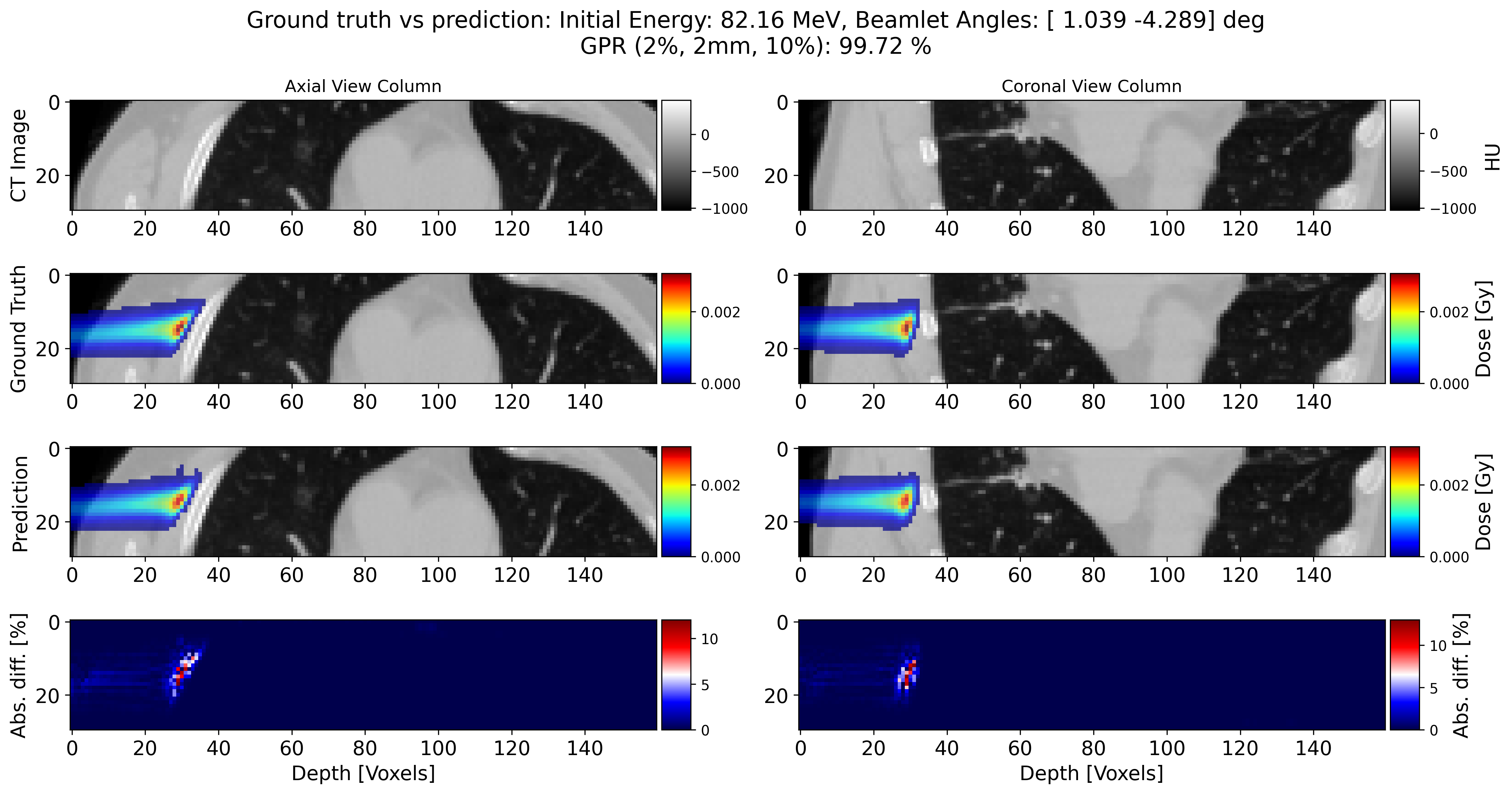
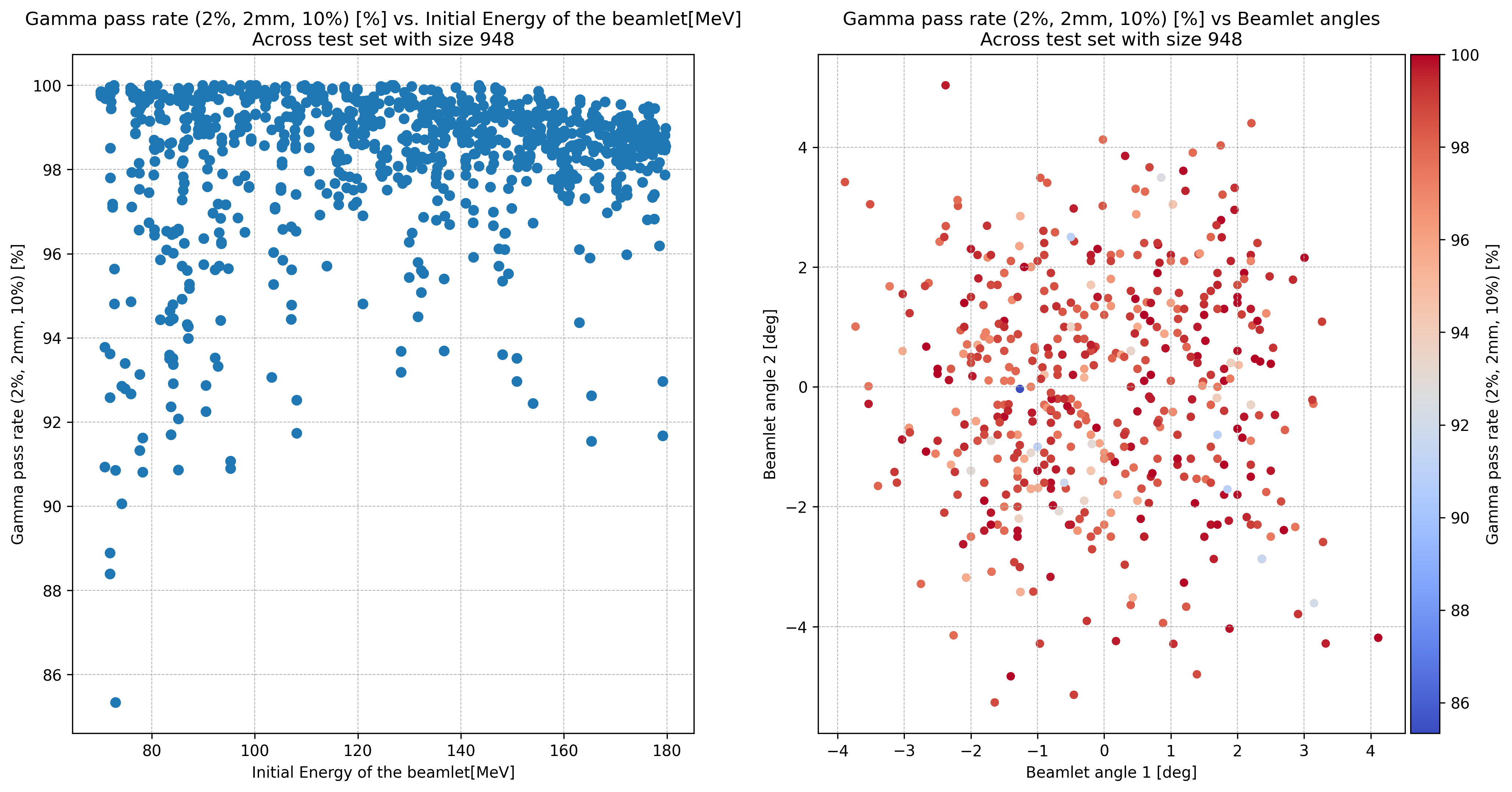
We evaluate on two separate testsets sampled from CT scans not used for training. The Lungs testset (948 samples, 20 CT scans) matches the training anatomy; the Abdominal and Pelvis testset (2363 samples, 60 CT scans) is an anatomical site not seen during training.
| Anatomical Site | Samples | Mean ± SD GPR (2%, 2mm, 10%) | Min GPR | Max GPR |
|---|---|---|---|---|
| Lungs testset | 948 | 98.34% ± 1.79% | 85.34% | 100.00% |
| Abdominal and pelvis testset | 2363 | 99.46% ± 0.63% | 93.66% | 100.00% |
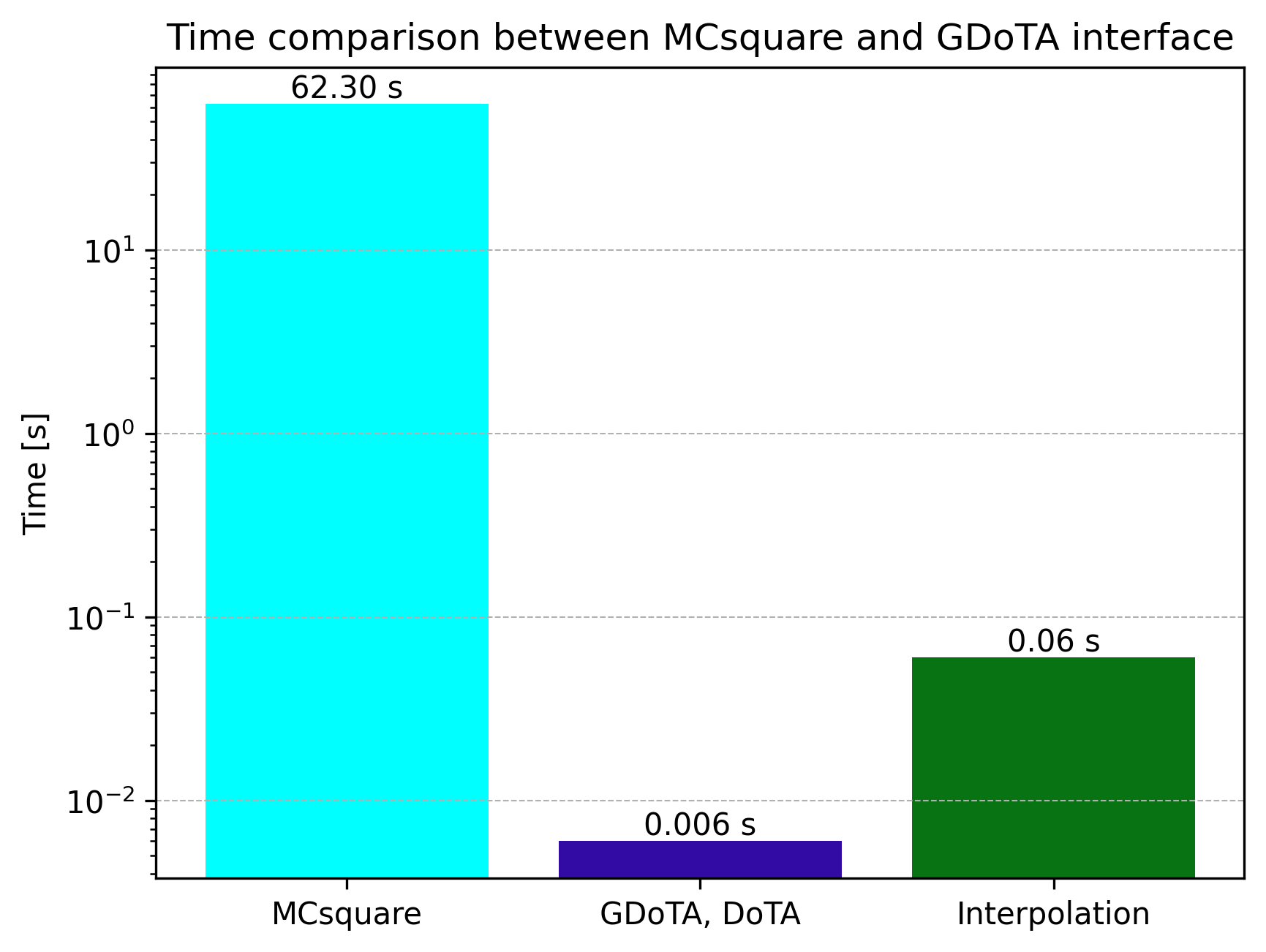
Beamlet-angle agnosticism — the core novelty — eliminates the need for 3D grid reinterpolation for each beamlet. The figure below compares dose calculation times between MCsquare, DoTA, and ADoTA. In DoTA, reinterpolation is performed for every beamlet; ADoTA requires only one reinterpolation per field.
Performance showroom
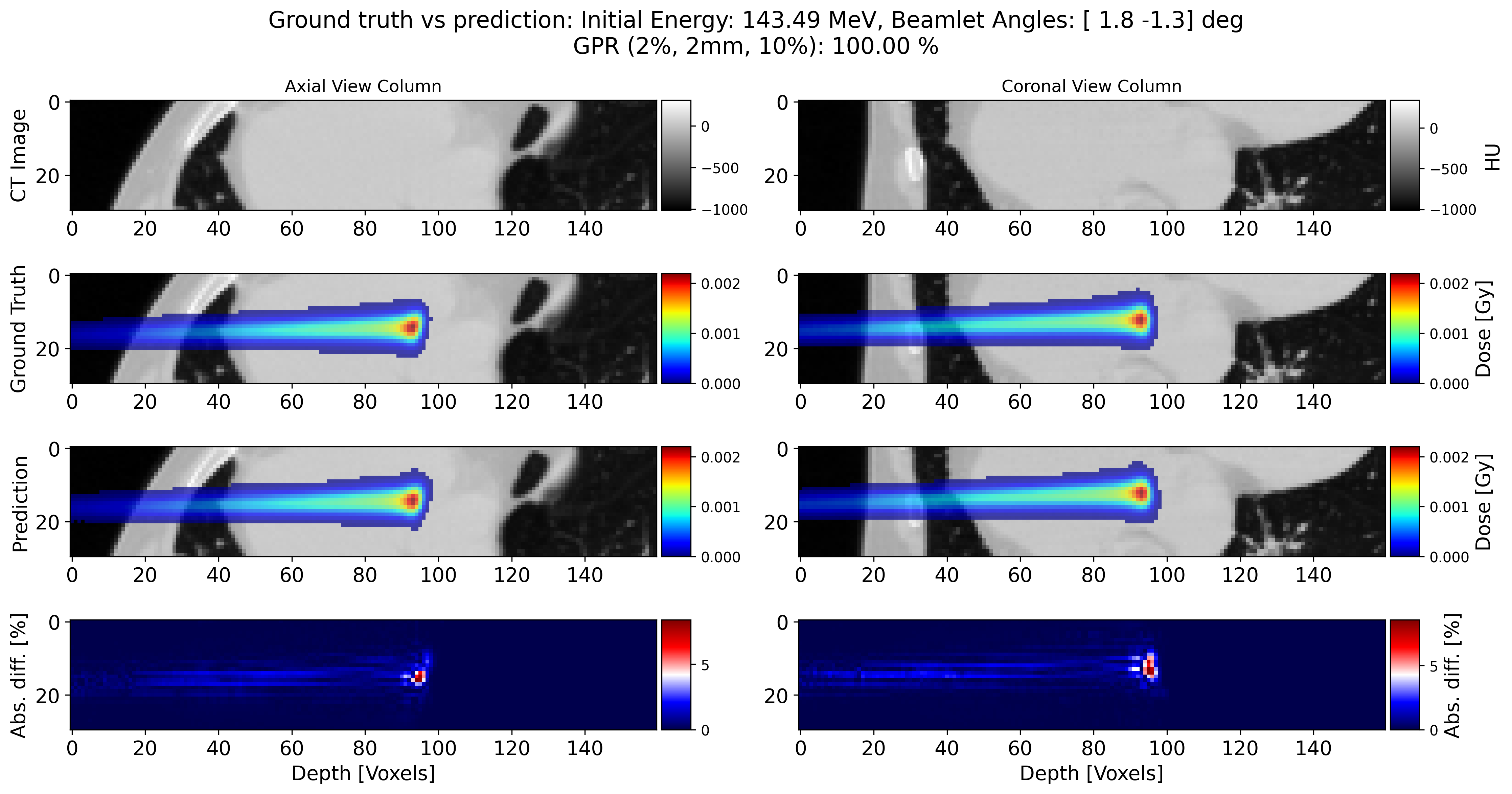
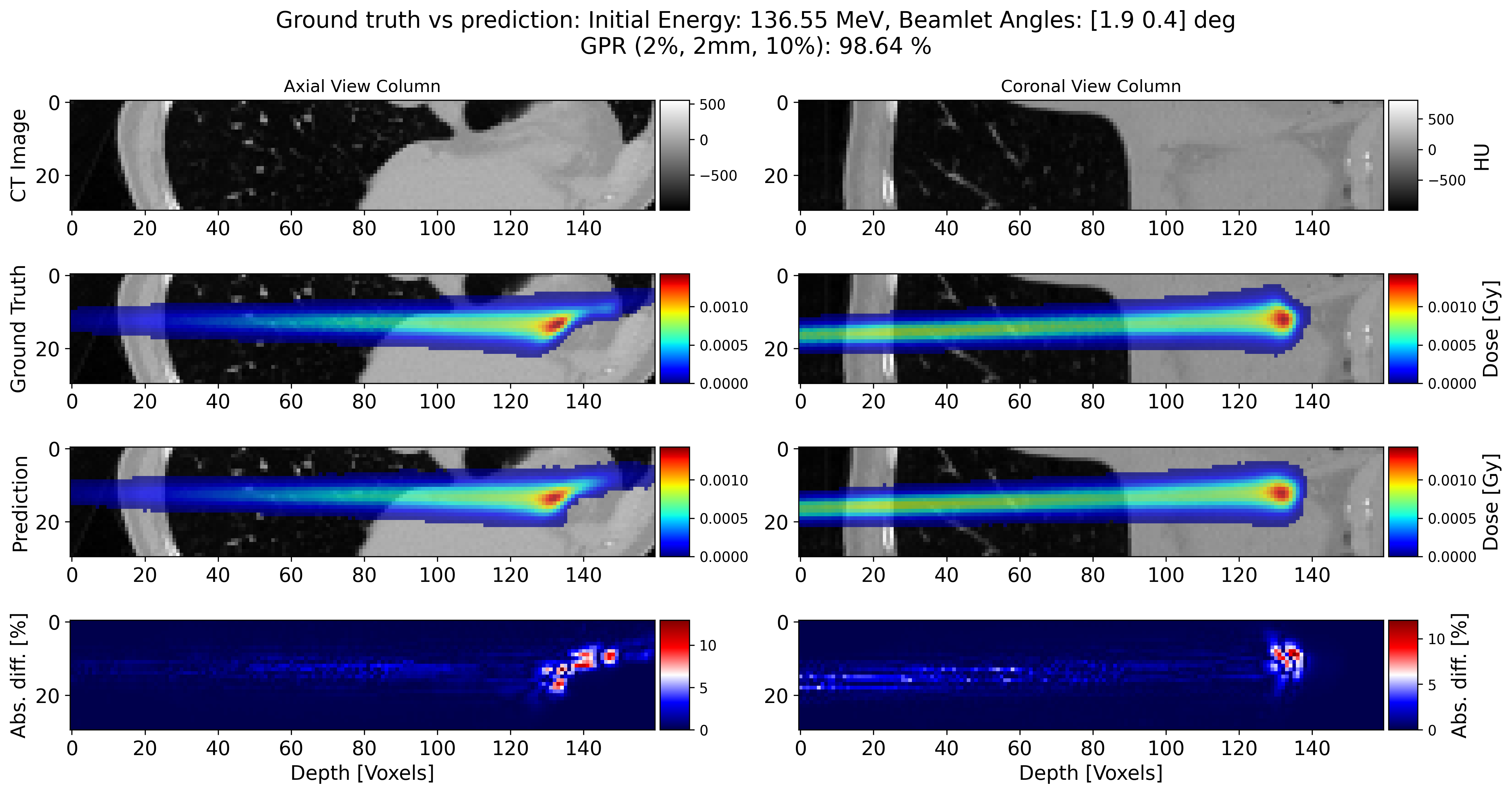
Examples of 3D dose distributions predicted by the model, compared against reference distributions from MCsquare.